USD to EUR — Live Rate, Historical Chart & Converter
US Dollar to Euro · Live exchange rate
Mid-market rate
Convert USD to EUR
Live conversion calculator
USD to EUR
Historical exchange-rate trend & past data
USD to EUR — Rate Analysis
The current USD/EUR exchange rate is 0.890515 Euro (EUR) per 1 US Dollar (USD). Conversely, 1 EUR equals 1.1229 USD. This mid-market rate was last updated on 2026-10-19 and reflects the midpoint between buy and sell prices in the global foreign exchange market.
Over the past 90 days, the USD/EUR rate has risen by 1.49%, moving from 0.876679 to 0.889757 EUR. The current rate sits 0.01829 above the 90-day average of 0.872226, indicating relative strength in USD against EUR during this period.
The 90-day high reached 0.894174 EUR and the 90-day low dipped to 0.855386 EUR. The current rate of 0.890515 is 0.003658 EUR below the 90-day high and 0.035129 EUR above the 90-day low, placing it 91% of the way between the low and high.
About the USD/EUR exchange rate
About US Dollar (USD) and Euro (EUR)
US Dollar (USD)
- ISO Code
- USD
- Symbol
- $
- Country / Region
- United States
- Decimals
- 2
- Issuing Authority
- Federal Reserve
Euro (EUR)
- ISO Code
- EUR
- Symbol
- €
- Country / Region
- European Union
- Decimals
- 2
- Issuing Authority
- European Central Bank
USD/EUR past data
Recent sampled historical rates
| Date | 1 USD = EUR | 1 EUR = USD |
|---|---|---|
| 2026-10-17 | 0.889757 | 1.1239 |
| 2026-10-14 | 0.891987 | 1.1211 |
| 2026-10-11 | 0.892571 | 1.1204 |
| 2026-10-08 | 0.892463 | 1.1205 |
| 2026-10-05 | 0.894174 | 1.1184 |
| 2026-10-02 | 0.888626 | 1.1253 |
| 2026-09-29 | 0.880226 | 1.1361 |
| 2026-09-26 | 0.877865 | 1.1391 |
| 2026-09-23 | 0.875175 | 1.1426 |
| 2026-09-20 | 0.870613 | 1.1486 |
| 2026-09-17 | 0.872361 | 1.1463 |
| 2026-09-14 | 0.864474 | 1.1568 |
What drives the USD to EUR rate?
USD to EUR is the single most-traded currency pair in the world — the BIS Triennial Survey puts it at roughly 22% of daily global FX turnover, and once you add the EUR/USD reverse leg it accounts for closer to 28%. Because liquidity is so deep, the rate is shaped less by individual transactions and more by two structural forces: the interest-rate gap between the Federal Reserve and the European Central Bank, and the relative health of the US versus Eurozone economies.
Fed versus ECB: the master variable
When the Fed raises rates faster than the ECB — as it did through 2022 and 2023 — the Dollar strengthens and USD/EUR falls (i.e., one Dollar buys fewer Euros). When the ECB matches or out-hikes the Fed, the Euro recovers. In our tracking, every 25 basis-point surprise in the Fed–ECB differential has historically moved USD/EUR by roughly 0.5–1.0% within a week.
Energy imports and the Euro's structural pressure
The Eurozone imports most of its energy, so oil and gas prices are a quiet but powerful driver. The 2022 energy shock is the single biggest reason USD/EUR tested parity that summer — Europe was paying roughly 5× more for natural gas than the US, draining Euros into global energy markets.
Historical context for USD to EUR
- July 2022: USD/EUR touched 1.00 — parity for the first time in 20 years, driven by Fed hikes and the gas crisis.
- April 2008: USD/EUR peaked near 1.60, the strongest the Euro has ever been against the Dollar.
- October 2000: USD/EUR bottomed near 0.82, when the Euro was barely a year old and the Dot-com era Dollar was king.
- 2014–2017: a long grind from 1.40 down to 1.03 as the ECB ran negative rates while the Fed hiked.
Best time to convert USD to EUR
The tightest spreads and the most movement happen during the London–New York overlap, 8:00 AM to 12:00 PM Eastern Time. That is when both the ECB and Fed are in the market, and liquidity for EUR crosses is at its peak. Avoid converting in the late New York afternoon or Asian session — spreads widen, and a single large order can move the rate against you. For a concrete walkthrough of converting $5,000, read our 5000 USD to EUR conversion guide.
How to get the best USD to EUR rate
- Use a multi-currency account (Wise, Revolut, Schwab) — the spread is typically 0.3–0.5%, versus 1.5–3% at traditional banks.
- Avoid airport and hotel exchange counters; their spreads routinely exceed 5%.
- For amounts above €10,000, ask your broker for an FX specialist desk — they'll quote in pips, not percentages.
- Check the ECB reference rate (published 16:00 CET) as a benchmark before transacting.
- Set a rate alert on USD/EUR; the pair's 90-day range typically spans 2–4%.
FX rates are volatile. Past performance is not a predictor of future movements; always verify the live rate before transacting.
USD to EUR — Frequently Asked Questions
Related Articles — USD to EUR
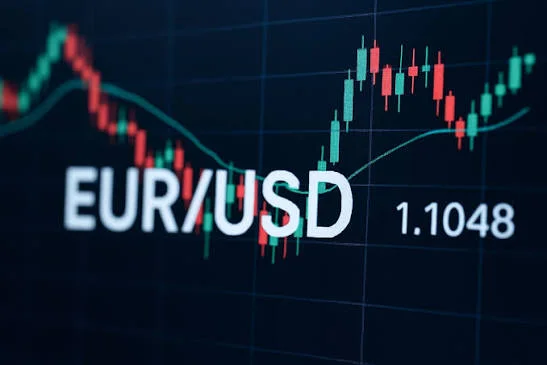
USD and EUR Complete Insights
Master the forces shaping USD/EUR — Fed vs ECB policy, inflation spreads, and the trend signals that matter before you convert.

USD to EUR: Live Rate, Conversion, and What Drives the Exchange Rate
Check the live USD to EUR rate, convert any amount, and learn what drives EUR/USD — Fed/ECB policy, inflation & energy.
200 EUR to USD: How Much Is 200 Euros in Dollars?
200 EUR = $215 at today's live rate. See the full conversion, what drives EUR/USD, and tips for converting any amount.
Popular EUR conversions
Inverse pair
EUR to USDView the reverse exchange rate — how many US Dollar (USD) you get for 1 Euro (EUR).