USD to PHP Historical Exchange Rate
See the USD to PHP historical chart and learn what drives the Dollar-Peso trend — 1-week to 1-year views.
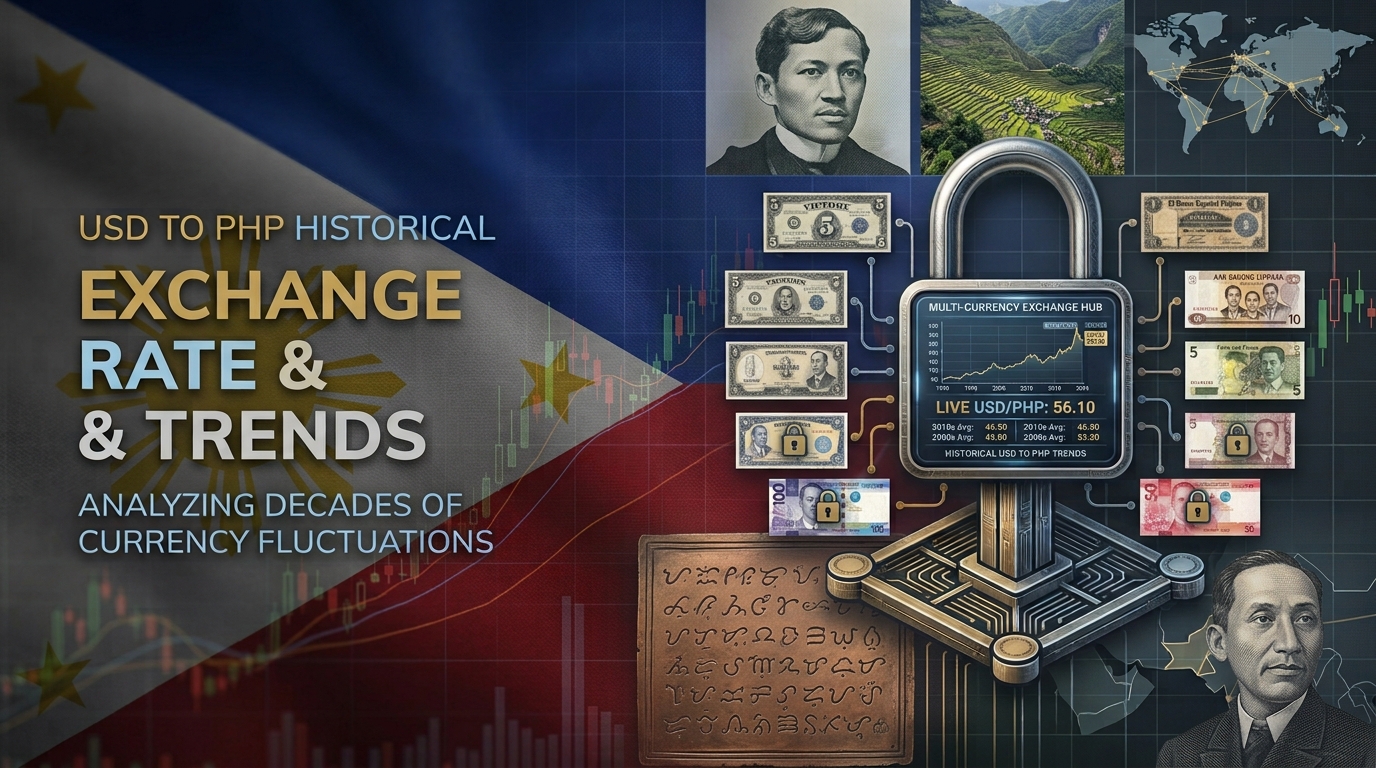
Quick Summary: The US Dollar to Philippine Peso (USD/PHP) exchange rate has moved significantly over the years, shaped by inflation differentials, US Federal Reserve policy, and the Philippines' reliance on remittances and trade flows. This guide explains how to read the USD/PHP historical chart, what's driven long-term trends, and how to use that context if you're planning a transfer, trip, or investment.
How to View the USD to PHP Historical Chart
You can see the full USD to PHP historical rate movement — from 1 week up to 1 year — on our live USD to PHP page. The chart updates continuously and lets you switch between timeframes to spot short-term swings versus longer-term trends.
When reviewing historical data, it helps to look at three things:
What to Check | Why It Matters |
|---|---|
1-year trend direction | Shows whether the Peso has been strengthening or weakening against the Dollar recently |
Volatility (how sharp the swings are) | Helps you judge whether now is a relatively stable or turbulent period to convert |
Recent vs. longer-term average | Tells you if the current rate is unusually high or low compared to its typical range |
What Has Historically Driven USD/PHP Movement
Several structural factors have shaped the USD to PHP rate over time:
Interest rate differentials — When the US Federal Reserve raises rates faster than the Bangko Sentral ng Pilipinas (BSP), the Dollar tends to strengthen against the Peso, as investors seek higher-yielding US assets.
Remittance inflows — The Philippines is one of the largest remittance-receiving countries in the world. Steady inflows from overseas Filipino workers (OFWs) provide consistent Dollar supply, which can help support the Peso.
Trade balance — The Philippines imports significant amounts of fuel and raw materials, creating ongoing Dollar demand that can weigh on the Peso, especially during periods of high global oil prices.
Global risk sentiment — During periods of global economic uncertainty, investors often move toward the US Dollar as a perceived safe-haven currency, which can push emerging market currencies like the Peso lower.
Domestic inflation — Higher inflation in the Philippines relative to the US tends to erode the Peso's purchasing power over time, a common pattern for many emerging market currencies against the Dollar.
Why Historical Context Matters for Your Transaction
Looking at historical trends isn't about predicting the future — exchange rates are influenced by too many variables to forecast reliably. But historical context is genuinely useful for:
Remittance timing — If you regularly send money to the Philippines, seeing whether the current rate sits near a recent high or low can help you decide whether to convert now or wait a few days.
Travel budgeting — Knowing the general range the rate has moved in recently helps you budget more realistically for a trip.
Understanding "normal" volatility — If you see a sudden rate movement, historical charts help you judge whether it's a typical daily fluctuation or a more significant shift worth paying attention to.
A free rate alert can also help here — instead of manually checking the chart, you can set a target rate for USD to PHP and get notified automatically when it's reached.
Frequently Asked Questions
Has the Philippine Peso historically weakened against the US Dollar? Over the long term, the Peso has generally trended weaker against the Dollar, largely reflecting inflation differentials between the two economies — a pattern common to many emerging market currencies. However, the rate has also seen periods of Peso strength, particularly when remittance inflows are strong or the Dollar weakens broadly.
What causes short-term spikes in the USD to PHP rate? Short-term movements are often driven by US Federal Reserve announcements, BSP policy decisions, global oil price changes, and shifts in broader market risk sentiment.
Where can I see the most accurate, up-to-date USD to PHP rate? Live rates, along with 1-week to 1-year historical charts, are available on our USD to PHP page, updated daily.
Check the live USD to PHP rate and chart now, or explore other currency pairs.