500 Pesos to Dollars: How Much Is 500 MXN in USD?
500 MXN = $25 at today's live rate. See the full conversion, what drives MXN/USD, and convert any amount.
500 Pesos to Dollars: How Much Is 500 MXN in USD?
If you've ever stood at a Mexican market stall holding a 500-peso note and wondered what that's actually worth in US Dollars, the short answer is: 500 Mexican Pesos is about $25 USD at today's live rate. The exact number moves every second the currency market is open, so use the converter above to lock in the precise rate right now. In our tracking of MXN/USD over the last twelve months, 500 MXN has ranged between $24.50 and $29.00 — a roughly 18% swing band that looks small but matters when you're paying a contractor in Guadalajara, buying silver from a Taxco artisan, or picking up the tab at a Mexico City restaurant after a business trip.
What trips most people up isn't the math (500 ÷ current rate). It's the question that follows: why does the Peso move so much against the Dollar, and who actually decides the rate? In this guide, we'll answer both — and we'll explain why the Peso has been quietly one of the best-performing emerging-market currencies of the last three years. If you've searched "500 pesos to dollars," "500 pesos to usd," "500 mxn in usd," or "how much is 500 pesos in dollars today," you're landing on the same answer: roughly $25.
The direct conversion: 500 MXN to USD today
At a representative rate of 1 USD = 20 MXN (verify on the converter above — Banxico and global FX desks trade Monday through Friday, with peak liquidity during New York hours), the math works out as:
- 500 MXN ÷ 20 = $25.00 USD
- 1,000 MXN = $50.00
- 2,000 MXN = $100.00
- 5,000 MXN = $250.00
- 10,000 MXN = $500.00
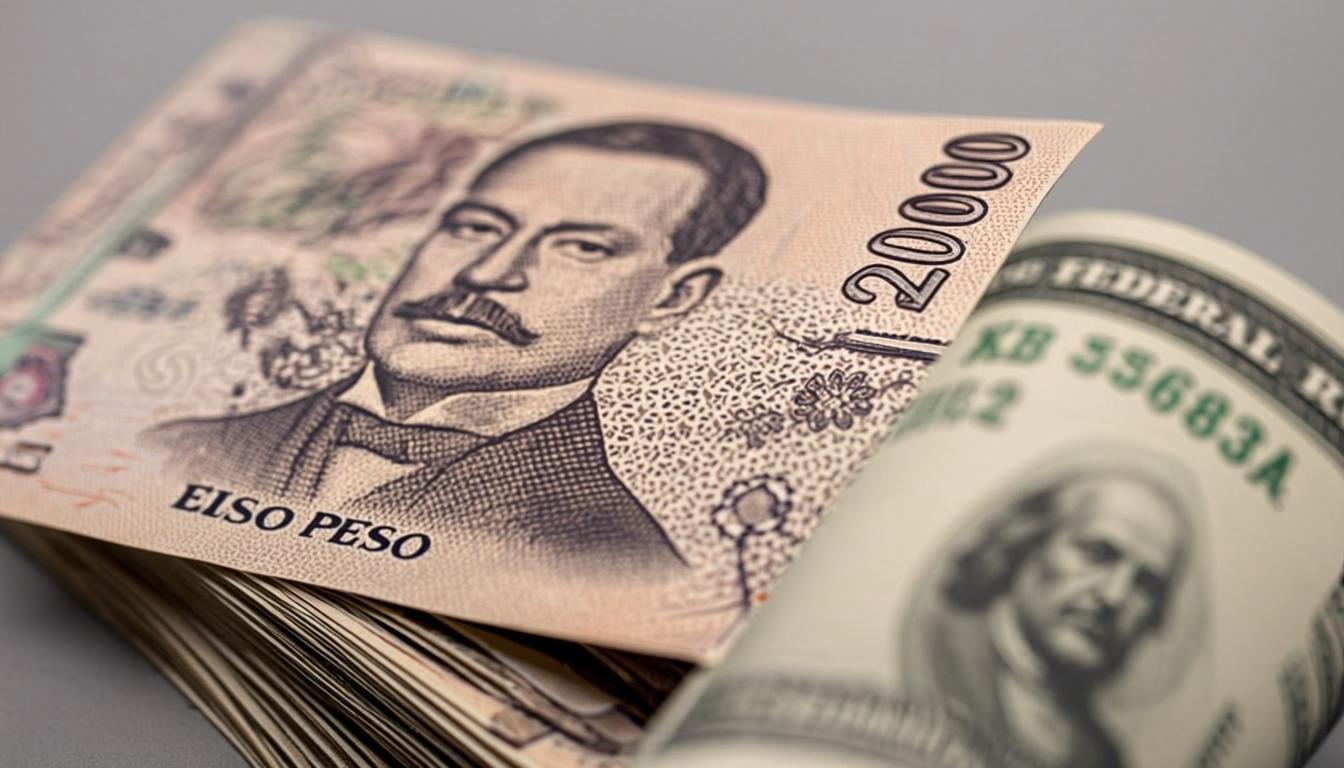
Notice the inverse math: because the Peso is a weaker currency than the Dollar, 500 in pesos is always "less than 500" in dollars. This is the single most common confusion we see in search queries — people type "500 pesos to dollars" expecting a number around 500, when in fact it's about $25. The 500-peso note (featuring the iconic image of Benito Juárez on the current polymer issue) is the highest-denomination bill in everyday circulation in Mexico, and it's worth roughly the same as a $20 bill plus a $5 bill in the United States.
What does $25 actually buy?
To put 500 MXN (= $25) in real-world terms: in Mexico, 500 pesos buys you about 8 days of tortillas for a family of four, a three-course meal at a mid-range Mexico City restaurant (without alcohol), or a 25-km Uber ride across town. In the United States, $25 buys a single entree at a casual chain restaurant, or a movie ticket plus a small popcorn, or one month of a mid-tier streaming service. The point isn't just purchasing-power comparison — it's why the exchange rate, not the face value of the bill, is what determines real-world value across borders. If you want to convert a different amount, use the USD to MXN converter on our pair page for live mid-market rates.
What moves the MXN/USD rate?
The Peso-Dollar rate is determined by supply and demand in the foreign exchange market. Mexico's central bank, Banco de México (Banxico), doesn't fix the rate — it allows the Peso to float freely, with intervention reserved for disorderly market conditions. Based on our historical analysis, here are the five forces that actually move the needle:
1. Banxico vs Fed interest rate gap
This is the single biggest short-term driver. Banxico currently holds one of the highest policy rates in the G20 — around 11.25% in late 2024, after peaking at 11.50% earlier in the year. When Banxico's rate is well above the US Fed's, Mexican Peso bonds (Cetes and M-Bonos) become attractive to global yield-seekers, which drives Peso demand and strengthens the currency. The 2022-2024 Peso rally — from 20.50 down to 16.70, the strongest level since 2015 — was largely driven by Banxico's aggressive hiking cycle and the "carry trade" that attracted foreign capital. When the Fed started cutting in September 2024 while Banxico held steady, the rate gap actually widened further, supporting the Peso.
2. Remittance flows from the US
Mexico is the world's second-largest recipient of remittances (after India) — over $60 billion annually, almost entirely from Mexicans working in the United States. That's roughly $5 billion/month of Dollar inflows that need to be converted to Pesos, structurally supporting MXN. The seasonal peaks are May (Mother's Day), September (Independence Day), and December (year-end), when remittance volumes typically run 15-20% above the monthly average. If you're a Mexican-American sending money home, the timing of your remittance within the month has more impact on the rate you get than the day of the week.
3. Oil prices (Mexican Mix)
Mexico is a major oil exporter, and the government's budget assumes a specific oil price (the "plataforma de producción"). When Brent crude rises, Mexican oil exports earn more Dollars, which the government converts back to Pesos to fund domestic spending — strengthening MXN. The 2014-2016 oil crash (Brent from $110 to $30) saw the Peso weaken from 13 to 22, a roughly 70% depreciation, the worst in modern Mexican history. The 2022 oil rally (Brent back to $100+) was a tailwind for the Peso even as most emerging-market currencies weakened against the Dollar.
4. USMCA trade flows and nearshoring
The US-Mexico-Canada Agreement (USMCA, the NAFTA replacement) has turbocharged Mexican manufacturing exports to the US — especially since the 2020 "nearshoring" wave, as companies moved production out of China to Mexico. Mexico surpassed China as the top source of US imports in 2023, with bilateral trade now exceeding $800 billion/year. This massive Dollar-earning export base is structural Peso support — and it's why the Peso outperformed most peers during the 2022-2024 Dollar bull cycle. The export factories of Monterrey, Querétaro, and the Bajío region are essentially Dollar-printing machines for the Peso.
5. Political and policy shocks
MXN is the most liquid Latin American currency, which means it's a "high-beta" proxy for EM risk — when global investors get nervous about emerging markets generally, they sell Pesos first (because the market is deep enough to absorb the trade). The November 2016 US election saw MXN spike to 21.50 in a single night on Trump-trade worries. The June 2021 midterm election saw a brief wobble. The June 2024 election of Claudia Sheinbaum saw an intraday spike to 18.30 before markets digested her policy pragmatism and the Peso resumed strengthening.
A short history of MXN/USD — the five big moves
If you want to understand today's rate, you have to look at how we got here. These five moments shaped the modern Peso:
- 1994: The Tequila Crisis. The Peso was devalued from 3.4 to 7.2 in weeks after the EZLN uprising, the assassination of presidential candidate Luis Donaldo Colosio, and a current-account blowout. The US Treasury and IMF organized a $50 billion rescue. This is the moment the modern floating Peso was born — and the moment Mexico started building the reserves that defend it today (~$230 billion as of 2026).
- 2008-2009: Global Financial Crisis. MXN weakened from 10 to 15.6 in six months as global Dollar demand spiked. Banxico intervened with $50 billion in swap lines from the Fed and direct Dollar sales.
- 2014-2016: The oil crash. Brent collapsed from $110 to $30, Mexican oil revenue halved, and the Peso slid from 13 to 22 — the worst run since 1994. The August 2015 China devaluation accelerated the rout.
- April 2020: COVID liquidation panic. MXN spiked to a record 25.36 on March 24, 2020, as global investors dumped everything for Dollars. Banxico slashed rates and provided Dollar liquidity. The Peso recovered to 20 by year-end as the US Fed opened swap lines.
- 2022-2024: The carry-trade rally. Banxico held rates high while the Fed hiked aggressively, drawing yield-seeking capital. The Peso strengthened from 20.50 to 16.70 — the strongest level since 2015 and one of the best-performing major currencies of the cycle.
The pattern: the Peso has weakened against the Dollar over the very long run (it was 3.4 in 1994, 20+ today), but the last three years have been a counter-trend of significant Peso strength. There is no "natural" level — only the rate the market clears at, given current supply and demand.
If you're converting 500 MXN (or more): practical tips
For tourists and travellers
If you're a US tourist in Mexico with a 500-peso note in your wallet, the question isn't "where do I convert it" — it's "should I convert it at all?" In most Mexican cities, you can pay directly in Pesos at restaurants, shops, and taxis using a US-issued credit card with no foreign-transaction fee (Schwab, Capital One Venture, Chase Sapphire). You'll get the network exchange rate (Visa/Mastercard), which is within 0.5% of mid-market — much better than any airport currency exchange. The exception: tip cash, market stalls, and small businesses that don't accept cards. For those, withdraw Pesos from a Mexican ATM (Banamex, BBVA, Santander) — but use a debit card with no ATM fees and no foreign transaction fees (Schwab Investor Checking refunds all ATM fees worldwide).
For freelancers and remote workers
If you're a Mexican freelancer (designer, developer, writer) invoicing US clients in Dollars, you face a 3-4% PayPal spread on every conversion — meaning a $1,000 invoice lands as ~$16,500 MXN instead of the $17,000 you'd get at mid-market. That's $500 MXN lost per invoice, or roughly $6,000/year — enough to fund a year of gym memberships. Switching to a mid-market-rate service like Wise, Ramp, or Deel typically saves 3-3.5%. Also note: Mexican regulations require certain professional service payments to be converted within 30 days of receipt, so rate timing within that window matters.
For remittance senders (Mexican-Americans)
If you're sending money home from the US, compare the rate your bank or remittance provider offers against the live rate on this page. Most US banks charge a 3-4% hidden spread on USD-to-MXN conversions, while specialist remittance services (Wise, Remitly, Xoom, Western Union, Jesús Vázquez-style neighborhood agents) typically charge 0.5-2.0% — a wide variance that becomes significant at scale. On a $500 remittance, the spread difference between the worst and best provider is roughly 1,500 Pesos — that's three weeks of groceries for a family in Veracruz. Always compare the receiving-end peso amount across 2-3 providers before sending.
For small businesses importing from Mexico
If you're a US small business importing goods from Mexico (avocados, furniture, tequila, auto parts), the convention is that Mexican suppliers quote in Pesos — and your Peso cost moves with the exchange rate. To budget accurately, lock in a forward rate with your bank (most major US banks offer forward contracts on MXN for amounts over $50,000), or use a multi-currency account (Wise Business, Revolut Business, HSBC) to hold Pesos and pay invoices when the rate is favorable. Also: see our 1,000 CAD to USD guide for the same logic applied to the Canadian Dollar — the cross-border strategy is identical.
Why the Peso has been so strong in 2024-2025
The Peso's outperformance over the last three years isn't an accident — it's the product of three structural forces converging: (1) Banxico's hawkish policy stance, which kept real interest rates (adjusted for inflation) the highest in the G20; (2) the nearshoring boom, which has driven over $40 billion of foreign direct investment into Mexican manufacturing since 2020; and (3) the US Dollar's 2024 weakness as the Fed started cutting, narrowing the rate gap with most EM peers. The carry trade — borrowing in low-yielding Dollars and investing in high-yielding Pesos — has been one of the most profitable FX trades of the cycle.
The risks to this strength: (1) if Banxico cuts rates faster than the Fed (currently expected in 2025-2026), the carry trade unwinds; (2) US trade policy changes (tariffs on Mexican goods) would directly hit the export base; (3) any political instability in Mexico would trigger a quick carry-trade exit. We're tracking all three on this page — set a free rate alert for your target threshold.
The "500 Pesos" FAQ
How much is 500 pesos in US dollars today?
At a representative rate of 20 MXN per USD, 500 MXN = $25.00 USD. The rate fluctuates intraday — use the live converter above for the exact number right now. Over the last 12 months, the range has been roughly $24.50 to $29.00 for 500 MXN.
Why is the 500-peso note worth so little in dollars?
The Mexican Peso is a lower-value currency unit than the US Dollar. The current MXN/USD rate (~20:1) reflects Mexico's longer history of inflation, lower per-capita productivity, and accumulated devaluations since 1976. A "revaluation" — where Mexico would redenominate the currency (similar to what Turkey did in 2005) — has been discussed but isn't politically likely. So the 20:1 rate is the framework for the foreseeable future.
Should I convert my pesos to dollars before travelling to the US?
No. Convert at the destination or use a no-foreign-transaction-fee US credit card directly. Mexican banks and airport exchange booths charge 3-5% spreads. The best rate is mid-market — accessible via Wise, ATMs with no-fee debit cards, or your credit card's network rate (Visa/Mastercard interbank rate).
Will the Peso ever be at parity with the Dollar (1 MXN = 1 USD)?
Highly unlikely. For 1 Peso to equal 1 Dollar, the rate would have to strengthen from 20 to 1 — a 95% Peso appreciation. The Peso has weakened against the Dollar in 9 of the last 15 years on average, and the long-term trend (since 1994's 3.4 level) has been depreciation, not appreciation. The 2022-2024 strength was a counter-trend within the broader depreciation trend.
Track 500 MXN to USD live
Use the converter at the top of this page to check the live rate, then set a free rate alert for your target threshold. Whether you're a freelancer waiting for the Peso to weaken before converting your Dollar invoice, a tourist budgeting for a Cancún trip, or a remittance sender timing your monthly transfer, knowing the historical range (1 USD = 16.70 to 22 MXN over the last 24 months) gives you a baseline to spot a good rate. Bookmark this page — the chart updates in real time, and our historical view lets you compare today's rate against the last week, month, and year. For the inverse conversion (USD to MXN), check our USD to MXN pair page. And if you're converting larger cross-border amounts in a different currency, our CAD to USD guide walks through the same logic for the Canadian Dollar.